

ipNX Advocates Infrastructure Sharing to Accelerate Nigeria’s Broadband Future at Lagos Chamber of Commerce and Industry ICTEL Expo
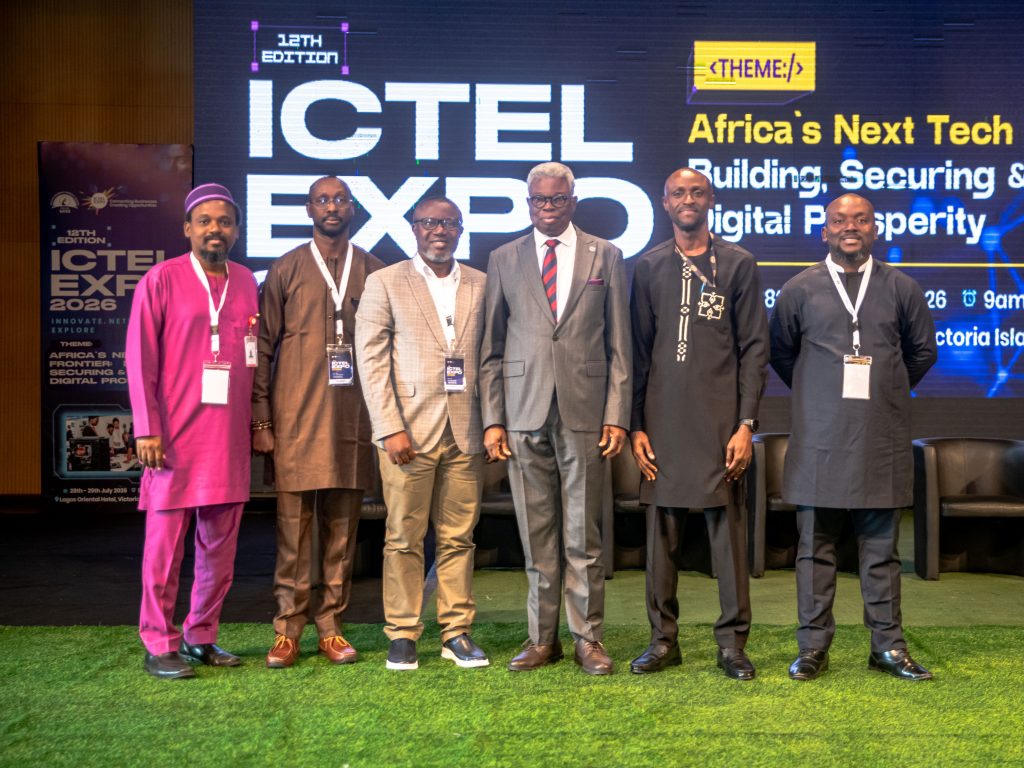
L-R: Oluwaseun Oluboyo, Panel Moderator and Chief Technology Architect, ipNX Nigeria; Oluseyi Lala, Divisional CEO, ipNX Business; Segun Okuneye, ICT Chairman, Lagos Chamber of Commerce and Industry (LCCI) and Deputy Director, Strategic Business Initiatives, ipNX; Engr Leye Kupoluyi, President, LCCI; Awa Kalu, Senior Manager, Fibre Sales Development, MTN Nigeria, and Obinna Adumike, Head, Converged Digital Infrastructure for Africa, Open Access Data Centres (OADC) at the 12th Edition of the LCCI ICTEL EXPO which held recently at the Lagos Oriental Hotel, Victoria Island, Lagos.
Leading Nigerian ICT company, ipNX, has called for stronger collaboration across the telecommunications industry and wider adoption of open-access infrastructure models to bridge Nigeria’s connectivity gap and accelerate nationwide broadband penetration.
The call was made during the first panel session of the recently concluded Lagos Chamber of Commerce and Industry (LCCI), ICTEL EXPO titled “Broadband, Fibre & Telecoms Infrastructure: Solving Nigeria’s Connectivity Gap.” The discussion brought together industry leaders to examine the barriers to broadband expansion and practical solutions for improving digital connectivity across Nigeria.
Speaking during the session, Oluseyi Lala, Divisional Chief Executive Officer, ipNX Business, highlighted the economic realities of broadband deployment, particularly in underserved and low-density communities.
“Deploying broadband infrastructure is capital-intensive,” Lala said. “The cost of building infrastructure, providing reliable power, transporting equipment to remote locations, and maintaining networks in difficult terrains significantly impacts deployment economics. These challenges become even greater in low-density environments.”
Lala also noted that while Nigeria continues to make progress towards its broadband penetration targets, improving the quality of broadband services must receive equal attention.
“Achieving Nigeria’s broadband ambitions will require more than fibre alone. We need to leverage both fibre and wireless technologies, encourage greater collaboration among operators, and embrace infrastructure-sharing models that reduce unnecessary duplication of investments.”
He stressed that competition within the industry should increasingly focus on service innovation, customer experience, and quality of service rather than duplicating physical infrastructure.

“If one operator has already deployed fibre along a route, there is little value in having multiple operators excavate the same corridor to install parallel infrastructure. We should instead explore innovative infrastructure-sharing models that optimise investments and accelerate network expansion.”
The panel also examined broader structural challenges affecting broadband deployment across the country, including the limited implementation of Right of Way reforms by state governments, multiple layers of taxation, security concerns, power costs, and regulatory complexities.
Also sharing his thoughts during the panel, Obinna Adumike, Head of Converged Digital Infrastructure for Africa at Open Access Data Centres, observed that Nigeria’s geography presents inherent connectivity challenges, noting that submarine cables land along coastal regions while extending connectivity inland requires substantial additional investment.
Adumike reinforced the need for operators to embrace infrastructure sharing, pointing out that the model has already proven successful globally.
“We should not continue duplicating fibre infrastructure,” he said. “Open-access and shared infrastructure models make network expansion easier, reduce costs, and improve access. This is not a new concept. The majority of submarine cable systems were built through joint ventures and shared investment models. Nigeria should adopt approaches that work for our local operating environment.”
Contributing to the discussion, Engr. Gbenga Adebayo, Chairman of the Association of Licensed Telecoms Operators of Nigeria (ALTON), called for protection of telecommunications infrastructure and stronger consequences for their damage.
He emphasised the need to define equitable contribution structure for infrastructure sharing models to ensure that early investors are not unfairly disadvantaged while also advocating a review of Nigeria’s telecommunications tariff structure to better reflect regional cost differences.
The discussions underscored the importance of stronger collaboration between government, regulators, infrastructure providers, and network operators to remove barriers to investment and improve broadband access nationwide.
As Nigeria pursues its target of increasing broadband penetration, ipNX reaffirmed its commitment to building resilient digital infrastructure, driving innovation, and partnering across the ecosystem to deliver faster, more reliable, and more inclusive connectivity for individuals, businesses, and communities across the country.
Do You Need More Trending Updates? Then kindly bookmark our blog Realgosipcenter.com.ng, we will update you with more latest musics in mp3 audio format and video in mp4 formats as soon as they drop for quick downloads.
Discover more from DailyNewsCover – Nigeria Breaking News, Politics, Business, Entertainment & Sports
Subscribe to get the latest posts sent to your email.