

Nigeria’s Small Businesses at a Crossroads: The High Cost of Staying Afloat
By Adeleke Olubanwo
…From unreliable electricity and expensive credit to multiple taxes and insecurity, structural challenges continue to threaten the competitiveness of Nigerian enterprises. Turning entrepreneurship into sustainable growth will require practical reforms and measurable results.
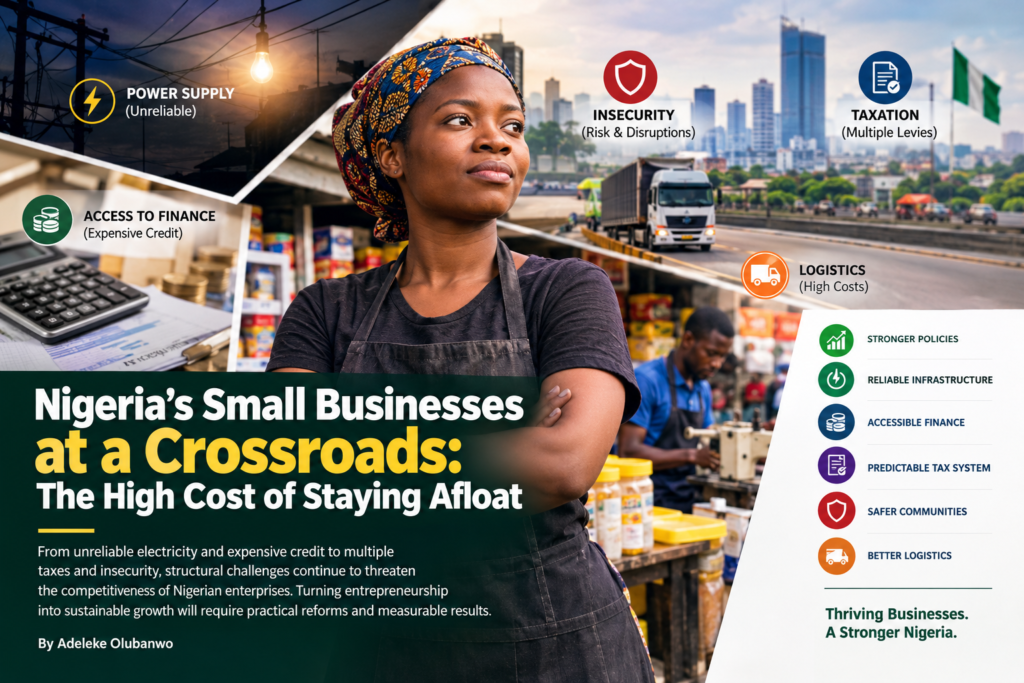
Nigeria’s small businesses are central to the country’s economic future. They provide goods and services, sustain livelihoods, support local supply chains and create opportunities for employment. Yet, for many entrepreneurs, the challenge is no longer simply how to establish a business, but how to keep it running, remain competitive and expand in an increasingly demanding operating environment.
From manufacturers and food processors to retailers, transport operators and digital entrepreneurs, businesses must contend with a combination of infrastructure deficiencies, financing constraints, regulatory pressures and security concerns. These challenges affect their ability to plan, invest, employ workers and deliver goods and services at competitive prices.
The Central Bank of Nigeria’s March 2026 Business Expectations Survey provides a useful picture of the difficulties confronting firms. The survey identified insufficient power supply, insecurity, high or multiple taxes, high interest rates and financial problems among the leading constraints reported by participating businesses. The findings underline the importance of addressing the structural conditions that determine whether Nigerian enterprises can move beyond survival towards sustainable growth.
Electricity costs and the struggle for competitiveness
Reliable electricity is one of the foundations of a productive economy. Businesses need consistent power to operate equipment, preserve perishable goods, provide services and maintain efficient production schedules.
When electricity supply is unreliable, enterprises may have to depend on generators, batteries, solar systems or other alternatives. Although these options can help maintain operations, they require additional investment and maintenance, adding to the cost of doing business.
For smaller enterprises, such expenditure can limit the resources available for expansion, recruitment, technology adoption and product development. Businesses may respond by adjusting prices, reducing operating hours or postponing investment.
The implications extend beyond individual companies. Higher production costs can affect the prices consumers pay, the competitiveness of locally manufactured goods and the ability of domestic enterprises to compete with imported products.
The CBN’s March survey placed insufficient power supply at an index of 74.5, making it the leading constraint identified by respondents. Insecurity followed at 70.9, while high or multiple taxes recorded 69.2.
These figures suggest that infrastructure and operating conditions remain important considerations for businesses, even as firms express expectations about future economic activity.
Improving electricity reliability should therefore be treated as an economic competitiveness priority. Investment in generation, transmission and distribution, alongside viable decentralised energy solutions, could help reduce interruptions and improve productivity.
However, the success of such interventions should be assessed by their practical effects: whether businesses receive more reliable electricity, whether operating costs become more manageable and whether firms can increase productive activity.
Access to finance: The missing link between ambition and expansion
Access to finance remains another important issue for Nigeria’s small business sector.
Entrepreneurs require capital to purchase equipment, maintain inventory, improve production capacity and respond to new market opportunities. Yet, financing can be difficult to obtain where interest rates are high, collateral requirements are demanding or repayment periods do not match the business’s cash flow.
The consequences can be significant. A business may have demand for its products but lack the funds needed to increase production. Another may need modern equipment to reduce costs but be unable to finance the investment. Others may rely on personal savings or informal borrowing, limiting the scale and sustainability of their operations.
The World Bank approved a $500 million financing package for Nigeria’s Fostering Inclusive Finance for MSMEs project in December 2025. The programme is designed to expand access to finance for micro, small and medium-sized enterprises through participating financial institutions, credit guarantees and other financing mechanisms.
According to the World Bank, the project aims to help expand financing to 250,000 MSMEs, including at least 150,000 women-led businesses and 100,000 agribusinesses. These are programme targets, not evidence that the intended results have already been achieved.
The initiative highlights the importance of connecting financing commitments with accessible and appropriately structured credit.
For businesses, the relevant questions are whether eligible enterprises can access the facilities, whether borrowing terms are sustainable and whether the funds help recipients improve productivity, create employment and expand operations.
Financial institutions can contribute by developing products suited to the needs of smaller businesses, improving the transparency of lending requirements and assessing creditworthiness through reliable financial records and transaction histories.
Entrepreneurs, in turn, can strengthen their prospects by maintaining accurate accounts, separating personal and business finances and developing realistic plans for investment and repayment.
The objective should be to ensure that finance supports productive activity rather than placing additional pressure on already constrained enterprises.
Taxation and the need for predictable regulation
Tax revenue is essential for funding public infrastructure and services. Businesses need functioning roads, reliable utilities, security and effective public institutions, all of which require sustainable public financing.
However, the business environment becomes more difficult when tax obligations are unclear, administrative procedures are burdensome or similar charges are imposed without adequate coordination.
The CBN survey identified high or multiple taxes as one of the major constraints reported by firms. For smaller enterprises, the challenge may involve not only the amount payable but also uncertainty about applicable charges, compliance requirements and the procedures for resolving disputes.
A more enabling environment requires clear rules, transparent administration and effective coordination among relevant authorities.
Digital tax systems, accessible guidance, verifiable payment records and straightforward dispute-resolution mechanisms can make compliance easier while supporting legitimate government revenue.
Predictability is particularly important for business planning. Entrepreneurs need to understand their obligations to calculate costs, set prices and make investment decisions.

Reforms should therefore be evaluated by whether they simplify compliance, reduce unnecessary duplication and create a more consistent relationship between businesses and public institutions.
The goal is not to remove the responsibility of enterprises to pay legitimate taxes. It is to ensure that taxation is administered transparently and does not impose avoidable barriers to productive investment.
Insecurity and the cost of moving goods
Security and transportation are also essential to a competitive business environment.
Enterprises depend on safe routes for moving raw materials and finished products, reliable access to markets and protection for workers, customers and business premises. Where insecurity disrupts commercial activity, businesses may experience delays, higher transport costs and uncertainty about supply.
Agricultural producers and food processors are particularly dependent on efficient movement between production centres, storage facilities, processing plants and markets. Disruptions along these chains can contribute to losses, reduce supply reliability and increase the cost of distribution.
For manufacturers and retailers, logistics difficulties can affect delivery schedules and inventory management, making it harder to meet customer demand consistently.
Improving security, maintaining transport infrastructure and strengthening supply-chain efficiency should therefore form part of a broader economic development strategy.
The benefits would extend beyond individual businesses. More reliable movement of goods can improve market access, support regional trade and help producers reach customers at lower cost.
Turning business-support programmes into measurable results
Nigeria has introduced and pursued initiatives intended to improve access to finance, infrastructure and economic opportunity. However, the existence of a programme does not automatically establish its effectiveness.
Business-support interventions should be assessed against clear outcomes. Financing programmes, for example, should report how many eligible enterprises receive loans, the terms of those loans, repayment performance and the extent to which participating businesses expand or create employment.
Infrastructure investments should be assessed by their effects on reliability, operating costs and productive activity. Tax reforms should be evaluated by whether compliance becomes simpler and more predictable.
Transparent reporting would help entrepreneurs understand which opportunities are available while allowing policymakers, researchers and the public to assess whether interventions are achieving their stated objectives.
It would also help identify gaps between policy design and implementation, enabling authorities to adjust programmes where results fall short of expectations.
A business-friendly environment requires not only policy announcements but also consistent implementation, credible monitoring and a willingness to improve interventions based on evidence.
The private sector’s role in building stronger enterprises
Although government policies and infrastructure have a major influence on the business environment, enterprises also have opportunities to strengthen their resilience.
Accurate bookkeeping can improve financial planning and support applications for formal credit. Digital tools can help businesses manage inventory, monitor transactions and reach customers. Better staff training, quality control and customer service can improve productivity and competitiveness.
Business associations can also help entrepreneurs share information, access training and engage collectively with policymakers on regulatory and infrastructure challenges.
Larger companies can support smaller suppliers through transparent procurement processes, technical assistance and fair payment practices. Such relationships can strengthen domestic supply chains and create opportunities for smaller enterprises to participate in larger markets.
These measures cannot substitute for reliable electricity, security or accessible finance. Nevertheless, they can help businesses make better use of available resources and prepare for expansion when conditions improve.
Measuring progress by what businesses can achieve
Nigeria’s business environment should ultimately be assessed by the opportunities available to productive enterprises.
Can a small manufacturer obtain financing to purchase better equipment? Can a food processor maintain reliable production without excessive energy costs? Can a retailer plan around clear tax obligations? Can a farmer or distributor move goods to market safely and efficiently?
These practical questions connect economic policy to the realities of enterprise development.
Government agencies, financial institutions, industry associations and research organisations can support better decision-making by publishing timely data on access to finance, enterprise survival, employment, electricity reliability and the performance of business-support programmes.
Such information would allow policymakers to identify persistent barriers and direct resources towards interventions that deliver measurable benefits.
It would also help distinguish between initiatives that are promising in design and those that have demonstrated results.
Conclusion: From surviving to growing
Nigeria’s small businesses have an important role to play in building a more diversified, productive and employment generating economy. But entrepreneurial ambition alone cannot overcome every structural barrier.
The CBN’s March 2026 Business Expectations Survey identifies electricity supply, insecurity, taxation, borrowing costs and financial difficulties among the constraints confronting participating firms. Meanwhile, the World Bank’s $500 million financing programme reflects efforts to address longstanding barriers to MSME finance.
The challenge now is to translate these initiatives and policy priorities into tangible improvements in the conditions under which businesses operate.
Reliable electricity, accessible finance, predictable regulation, effective security and efficient transport can help enterprises devote more resources to production, innovation, recruitment and expansion.
Progress should be measured not simply by the number of programmes announced or funds committed, but by whether viable businesses can invest, compete and create sustainable employment.
For Nigeria, the task is to build an environment in which entrepreneurship becomes more than a means of economic survival. It must become a realistic pathway towards stronger enterprises, productive jobs and long-term economic growth.
Sources: Central Bank of Nigeria’s March 2026 Business Expectations Survey, as reported by BusinessDay on April 10, 2026; World Bank press release on the FINCLUDE project, December 19, 2025.
Do You Need More Trending Updates? Then kindly bookmark our blog Realgosipcenter.com.ng, we will update you with more latest musics in mp3 audio format and video in mp4 formats as soon as they drop for quick downloads.Discover more from DailyNewsCover – Nigeria Breaking News, Politics, Business, Entertainment & Sports
Subscribe to get the latest posts sent to your email.